Agents Like OpenClaw Should Be Tested Like Applications, Not Evaluated Like Models
Why simulation-based system testing is the missing layer in the agent stack

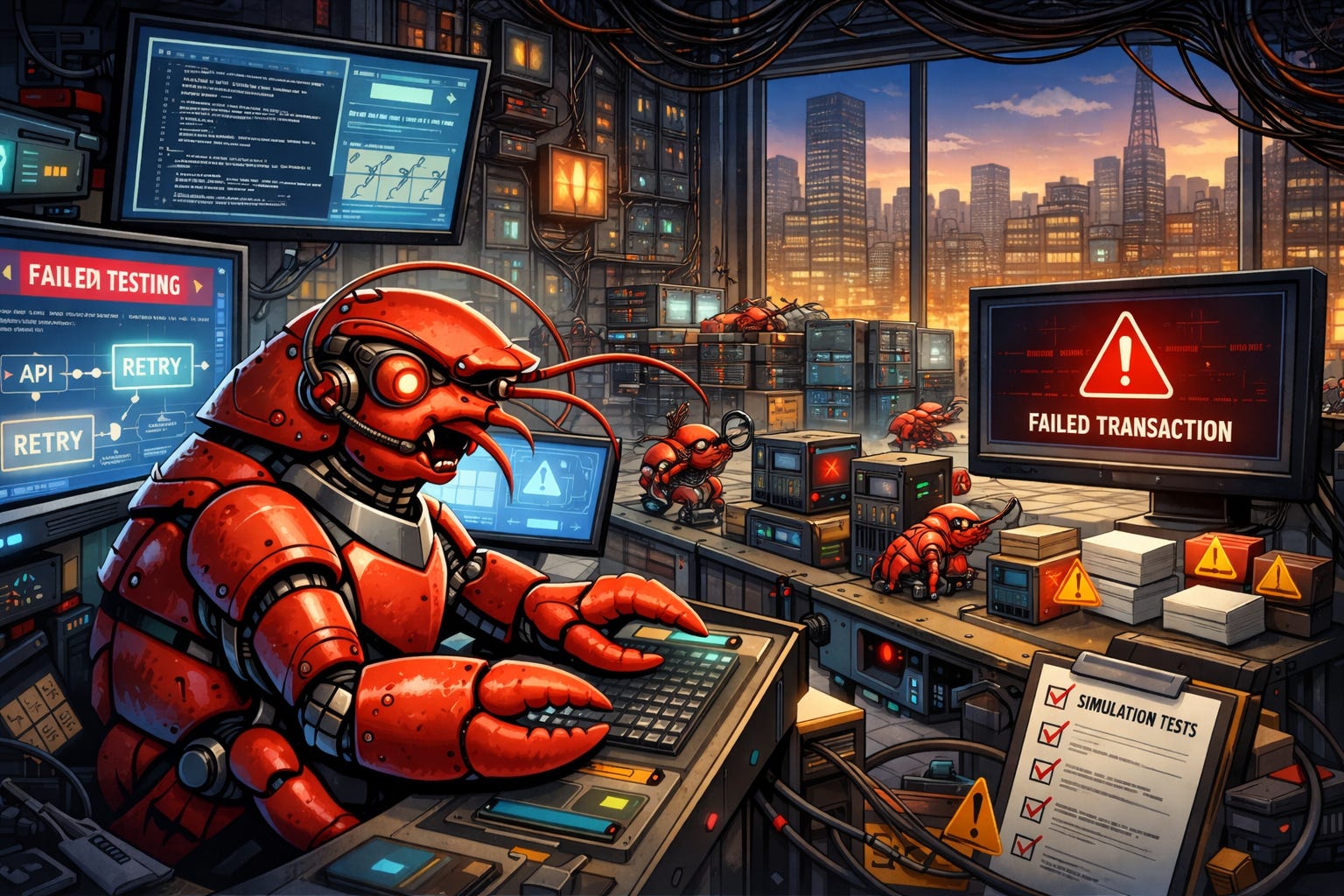
The recent surge of interest in agent frameworks, especially systems like OpenClaw, signals something important. We are no longer satisfied with isolated model calls and static prompts. Developers now expect agents to reason across turns, orchestrate tools, maintain state, recover from failures, and operate autonomously inside real workflows.
OpenClaw has made this shift tangible. What once looked like research demos are quickly becoming systems that book tickets, manage tasks, retrieve information, and execute multi-step flows. The gap between experimentation and production is shrinking.
As that gap narrows, a foundational question becomes unavoidable:
How do we know these agents behave correctly before we let them operate in real environments?
Most of today’s ecosystem answers that question with evaluation.
Evaluation focuses on outputs. It asks whether a response is correct, whether it matches expectations, whether it satisfies a rubric, or whether it achieves a benchmark score. That framing made sense when our primary concern was language quality.
But OpenClaw-style agents are no longer just models.
They are systems.
OpenClaw as a System, Not a Model
An OpenClaw-style agent is not merely a prompt wrapped in a loop. It is a stateful orchestration layer coordinating reasoning, tool calls, retries, and memory across multiple turns. It interacts with APIs, persists context, and produces side effects that may impact downstream infrastructure.
In other words, it behaves like an application.
Applications fail differently from models.
A model may fail by hallucinating a fact. An agent may fail by executing an action twice. A model may generate an incorrect sentence. An agent may partially complete a workflow and leave external systems in an inconsistent state.
Consider a simple purchase flow.
A user asks an OpenClaw-based assistant to buy an item. The agent retrieves pricing data, calls a payment API, and attempts to confirm the transaction. The payment API times out. The agent retries. During the retry, a subtle shift in conversational state alters the internal context. The second payment call succeeds, but due to the retry logic, the order is submitted twice.
If you inspect individual responses, everything may look reasonable. An evaluation rubric might pass. There is no obvious hallucination.
Yet the system behavior is wrong.
The failure does not exist in a single output. It emerges from the interaction between state, retries, and side effects across time.
This is not an output-quality issue.
It is a system-level failure.
Evaluation Is Necessary, But Not Sufficient
Evaluation remains important. It ensures that generated responses are coherent and aligned. It helps compare prompts and models. It improves language quality.
But once agents orchestrate workflows and interact with real systems, evaluation alone cannot guarantee correctness.
In traditional software engineering, we do not validate services by scoring responses. We run integration tests to verify component interactions. We inject failures to observe recovery behavior. We simulate edge cases. We perform stress testing. We validate behavior under controlled conditions before deployment.
These practices exist because systems fail in ways that are invisible from a single response.
As OpenClaw and similar frameworks increase agent autonomy, we must adopt the same discipline.
Agents should not only be evaluated.
They should be tested.
The Missing Layer: Reproducible Simulation
One immediate objection arises: large language models are inherently non-deterministic. Even with the same inputs, responses may vary across runs. The agent under test may also behave probabilistically.
This is true.
But perfect determinism is not the requirement.
Reproducibility is.
In production software systems, reproducible testing environments allow engineers to recreate failures, inspect execution traces, and validate fixes. Logs do not need to be identical at every byte. What matters is that behavior can be recreated under controlled conditions.
The same principle applies to agent testing.
A simulation does not need to generate identical text on every run. What it must provide is a controlled structure in which:
• The scenario definition is fixed
• Failure injections are intentional
• Execution traces are captured
• Behavioral outcomes are comparable
Without reproducibility, failures become anecdotes. A bug appears once and cannot be recreated. A regression is suspected but never verified. Debugging becomes guesswork.
Reproducible simulation changes that dynamic.
Instead of asking whether the exact wording matches, we ask whether the behavioral contract holds.
Did the agent complete the workflow exactly once?
Did it recover correctly from a timeout?
Did it mutate external state consistently?
Reproducibility is what allows agent behavior to enter CI pipelines. It enables regression detection across versions. It turns probabilistic systems into testable systems.
Perfect determinism may be impossible in probabilistic architectures.
But controlled reproducibility is not.
And that distinction determines whether agents can be engineered with discipline.
Riding the OpenClaw Wave Responsibly
The momentum around OpenClaw is exciting because it demonstrates what autonomous agents can do. Developers are building more ambitious workflows. The capabilities are real.
But as capability increases, so does responsibility.
If we treat OpenClaw agents as models, we will continue optimizing for output scores.
If we treat them as applications, we will optimize for behavioral correctness under real-world conditions.
Those two paths lead to very different outcomes.
As more teams experiment with OpenClaw in production-like environments, system-level failures will stop being theoretical. They will be operational and expensive.
The earlier we adopt a testing mindset, the more resilient the ecosystem will become.
What We Are Exploring
We have been experimenting with reproducible, multi-turn simulation flows for OpenClaw-style agents that treat them explicitly as systems under test.
The goal is not to replace evaluation, but to complement it with behavioral validation.
We are working toward open-sourcing a narrow, developer-first slice of this approach, focused on reproducible simulation and CI-friendly execution, so teams can begin integrating system-level testing into their workflows.
It will not solve every reliability challenge.
But it is a step toward shifting the mental model from scoring outputs to validating systems.
A Founder’s Perspective
The evolution from model to agent represents more than a technical upgrade. It represents a shift in responsibility.
When software begins to act autonomously, calling APIs, updating systems, and interacting with users, reliability stops being optional.
Evaluation was sufficient when we were optimizing language.
Testing becomes essential when we deploy systems.
Agents like OpenClaw are powerful. They are unlocking new forms of automation and interaction.
If we want that power to scale responsibly, we must treat these agents not as models to be scored, but as applications to be tested.
Because once agents move from demos into production, failures stop being interesting.
They become expensive.